Art
III
The Death of Socrates
Jacques-Louis David
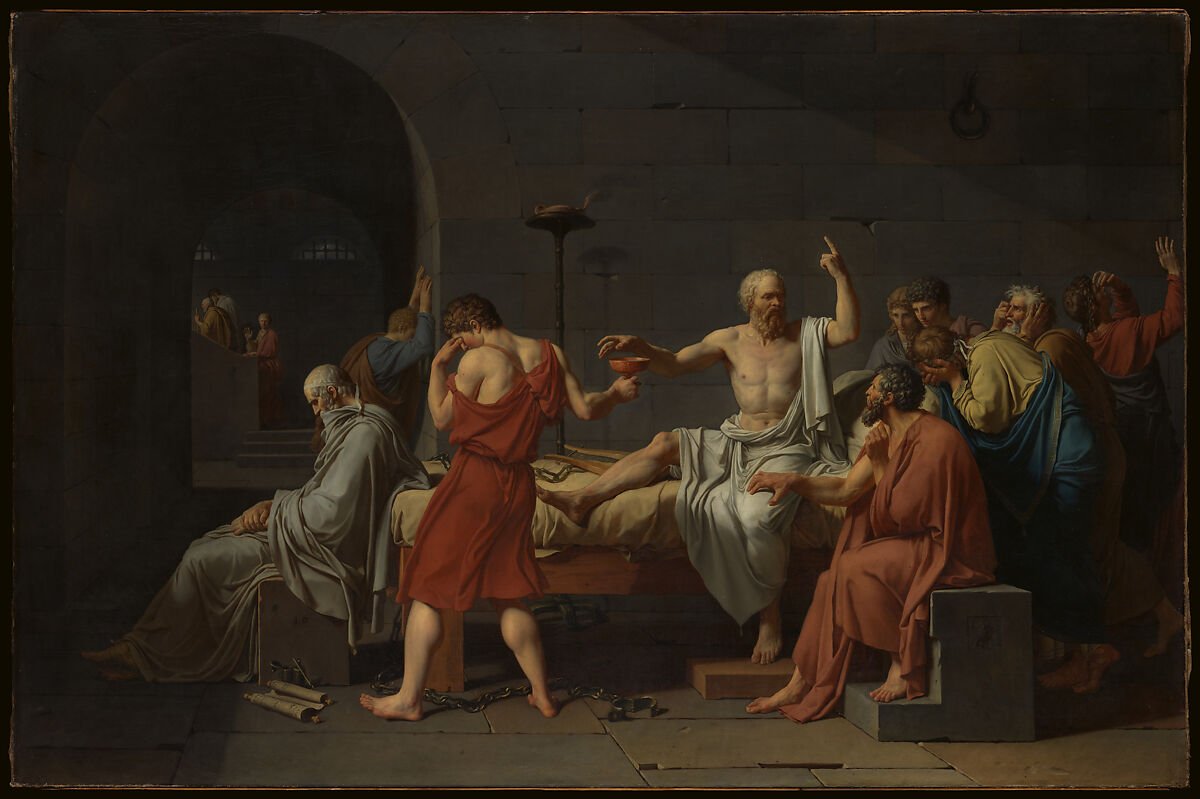
1787 · Oil on canvas · The Metropolitan Museum of Art, New York
Mailing List
Stay up to date with latest pieces and news
Art
III
Jacques-Louis David
1787 · Oil on canvas · The Metropolitan Museum of Art, New York
Stay up to date with latest pieces and news
Socrates is condemned to death by consumption of Hemlock for corrupting the youth and rejecting the gods. Nothing in this painting is accidental, nothing is trivial. David spent a year researching, sketching drafts, and composing this image. Even such things as the extension of the finger, or the placement of the window, both of which were repainted, carried a depth of meaning for David that could not be overlooked.
The Cup
The cup of hemlock, the death sentence, is at the dead centre of the image. At the mathematical midpoint. Death is at the fulcrum. David is telling us that we must look at it more than anything. The execution of this man. The Death of Socrates.
But what is above the cup is Socrates' hand, it's higher than the cup. His hand is relaxed, waiting for death to be handed to him and receiving it on his terms.
On one side of the cup, of death, is Socrates. He is busy teaching his students to his last moment, and not touching death for his soul is immortal: one of his deepest beliefs. On the other side is the executioner. Holding on to death, attached to it, but unable to look at it. He is afraid of it.
Socrates
Socrates is the highest figure in the painting. His body is strong and powerful, even though he was seventy when he died. Socrates had a life long commitment to civic duty and was an athlete in his own right. He was heavy infantry which meant he fought with up to 30kg; including armour, shield, and spear, and famously went barefoot in the ice and snow. He also wrestled, ran, and did solo dancing. For Socrates, physical neglect was a moral failing.
He is upright while the men around him are bent, collapsing in on themselves. Socrates did the moral work. He used to meditate, standing in one spot, for a day and night. He built himself into the man who can stand up straight, and welcome death with strength. His right hand is reaching for the cup, X-ray shows that David purposefully made his hand look more relaxed, instead of reaching - accepting, waiting. His left hand points to the sky, to the immortal realm.
Executioner
The bright red, the symbol of blood and mortality, contrast with Socrates' divine white. Red, the colour of the state, the men who decided to kill him for the things he taught. Covering their eyes and looking away. Ashamed and cowardly. They know they are killing the best of them, and they are doing it blindly. An act of willful blindness.
Plato
Like Socrates, Plato is wearing white, divine and pure. Plato was 28 when Socrates died, here he is an old man. That's because this image isn't actually happening, it's something Plato is remembering. The scroll and inkwell on the floor next to him, he's been writing. As he writes he's remembering Socrates' death for which Plato was not present. The memory blooms like a cloud from the back of Plato's mind into this scene of how he remembers his teacher. Examinations by The Met show that there is a tiny hole just above Plato's head, where David marked the vanishing point: where all parallel lines converge. It's why the light shines the way it does, why the corridor leads away in that direction, the entire image is a projection of his mind. All except the figures leaving the scene.
Xanthippe
Socrates' wife, Xanthippe, is hidden in the darkness of the archway, leaving the prison. She is not in the projection of Plato's memory, nor is Socrates looking at her. She is forgotten - but not by David. She is raising her hand in farewell to her husband. Socrates has his back to her. He has his back to the exit. He has his back to the life he could have if he escaped the prison, the life he could have had with his wife. X-ray shows that David purposefully painted over Xanthippe to make her less noticeable, to push her into the background, just as Socrates had done. In the Phaedo it's said that she was present at his death, and that she grieved terribly. David no doubt knew this, and judged that Socrates gave more attention to his teaching than his family, just as he had always done.
The Chains and Incense
Incense is burning behind him but gives almost no light. The light that is shining on Socrates gives him a bold and black shadow. The incense casts no shadow, only the stand does. Incense was burnt when they were praying to the gods, but the old gods were dying, burning dimly. They were being replaced by the beliefs Socrates preached; they cast no shadow.
Chains are at his feet, unlocked. He is choosing his death freely. But his ankles still bear the subtle red mark of having been chained. He was given the choice and he didn't run. He bears the marks of imprisonment but at the moment of his death he is a free man.
Crito
Here is a man who loved Socrates enough to arrange for his escape. He is the only man in the painting still holding onto Socrates, unable to let him go, not understanding why Socrates refused. Why would he choose death over escape and freedom? Look closely at the block Crito is sitting on, you will see three things painted on it. There's an owl, with the word ΑΘΕΝΑΙΩΝ — "of the Athenians" written next to it. And at the bottom is David's full signature.
The owl of Athena is the symbol of wisdom. Crito is sitting atop divine wisdom, but does not possess it. He is touching the wisest man of all, yet cannot understand why Socrates is doing what he's doing. He hasn't integrated wisdom in the way Socrates has, and so he still has one foot on the ground, while Socrates' feet do not touch the ground. ΑΘΕΝΑΙΩΝ, the state itself, the people who were killing him next to Athena's owl, the symbol of wisdom. The folly of the state next to the wisdom they espouse. Beneath both is David's full signature, put exactly where David connected most with the painting; the block where Crito sat. He recognises the love for wisdom, recognises what Crito recognised, but still cannot understand why Socrates chose to die.
The Last Supper
Fifteen people were present at Socrates' death according to Plato. But counting all the figures except for Socrates, David painted twelve people surrounding him. The twelve disciples. The artist is drawing a clear parallel between Socrates and Jesus Christ. Both men were condemned to death for telling the truth, and for trying to change the minds of ignorant people. Both men chose to die, both could have escaped if they wanted to, but accepted death as a duty. Both men died surrounded by people who loved them, and people who did not wholly understand why they had to die. ‘O my Father, if it be possible, let this cup pass from me: nevertheless not as I will, but as thou wilt’ (Matthew 26:39, KJV). Jesus asked to be spared by God, something Socrates did not do; but then he accepted the will of God, just as Socrates accepted the silence of his god, when that inner voice, his guiding spirit, did not protest his death. Both had faith in their gods, in something higher, and both were willing to die for them.
A final note:
This painting was commissioned by the Trudaine brothers, wealthy aristocrats who were friends and patrons of artists like David. They wanted the painting to show Socrates dying righteously for his principles. Seven years later they themselves were executed by the state for their political beliefs.